Professor Christian Hasse has been awarded a prestigious Advanced Grant from the European Research Council (ERC) for the A-STEAM (Aluminum STEAM combustion for clean energy) project. The project focuses on researching aluminum as an energy source and will receive around €2.5 million in funding over five years.
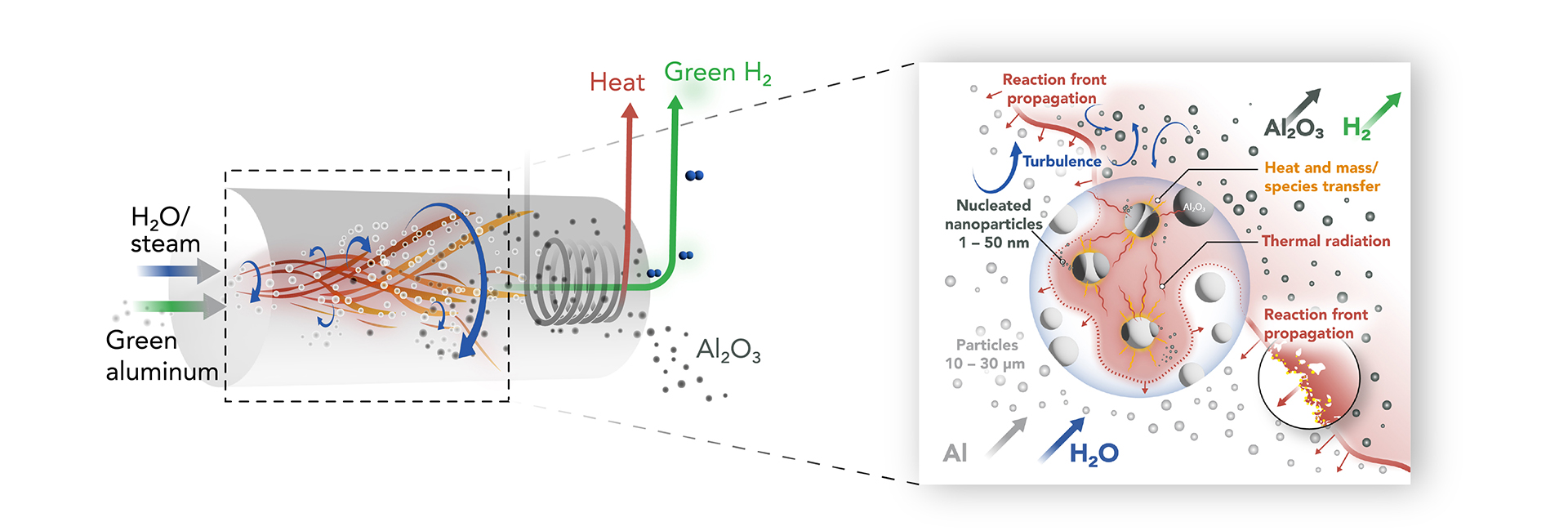
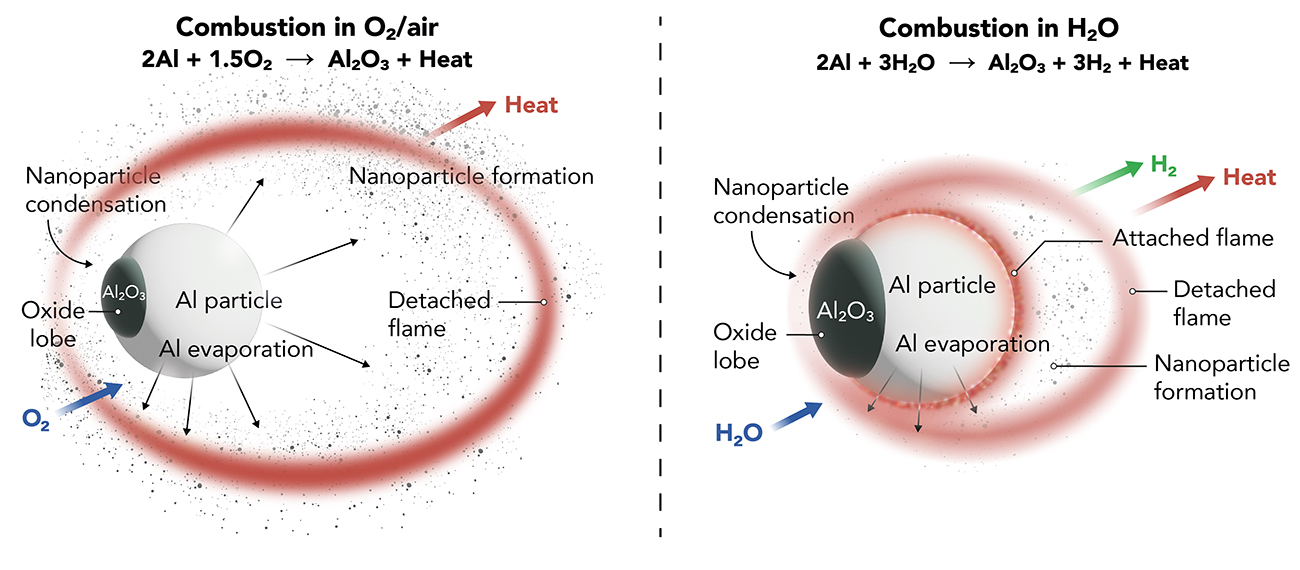
Aluminum powder is particularly energy-dense and is used, for example, in the boosters of the Ariane 5 rocket. This high storage capacity can be exploited for a highly innovative approach to decarbonizing industry. In this process, aluminum is oxidized with steam at high pressure. This produces two high-quality products on demand: high-temperature heat up to 1000°C and hydrogen, which can be used for electricity production or for synthesis in the chemical industry. Unlike conventional combustion processes with oxygen, steam oxidation enables lower flame temperatures, thus minimizing the formation of difficult-to-handle aluminum oxide nanoparticles.
The A-STEAM project combines simulations, modeling, and experiments to investigate the fundamental processes of pressurized aluminum vapor flames – from individual particles to turbulent flames with millions of particles.
 © A-STEAM
A-STEAM addresses a fundamental challenge facing the hydrogen economy: the energy-intensive and loss-prone transport of hydrogen under extreme conditions (-253°C or >300 bar pressure). Instead, aluminum as a “hydrogen carrier” enables safe storage and transport via existing infrastructure, with hydrogen only being produced at the destination as needed.
This property makes aluminum an ideal partner for hydrogen in a technology-neutral energy system:
Long-term storage without pressure loss or evaporation
Safe transport logistics via conventional transport routes
Scalable application from decentralized to industrial scales
Complete recyclability through reduction with renewable energies
A-STEAM embodies the characteristic “Darmstadt model” of close integration between simulation and experimentation. Professor Hasse and his team at the Department of Simulation of Reactive Thermo-Fluid Systems (STFS) develop high-resolution numerical models that cover the entire scale range from individual micrometer particles to turbulent flames with millions of particles. This enables them to investigate the fundamental processes of pressurized aluminum vapor flames.
The methodological approach includes:
Fully resolved direct numerical simulations (FR-DNS) at particle level
Novel particle-in-cell (PIC) models for considering different combustion regimes
Large eddy simulations (LES) for turbulent, technically relevant flames
Customized experiments to validate simulation results
 © A-STEAM
The resulting numerical-experimental reference database on aluminum vapor flames, together with scientifically based best practice guidelines for future aluminum burners, will strengthen the community in the field of metallic energy carriers and support future system development and the implementation of this CO2-free technology.
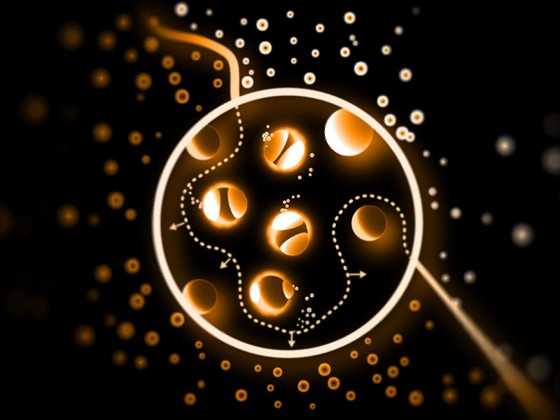
At the individual particle level, the physical and chemical processes are linked to ignition, the formation of oxide structures, and various flame structures.
The behavior of particle groups influences the regime of group combustion and flame propagation, so that the investigation provides valuable insights into flame stabilization.
Turbulent flames on a system scale are the basis for the future use of aluminum as an energy source.
The dynamics and mechanisms of nanoparticle formation are investigated through simulations and experiments, thereby optimizing the efficiency of the process.
A-STEAM is systematically developing the groundbreaking findings of the Clean Circles cluster project. While Clean Circles laid the foundations for iron-based energy storage, A-STEAM is expanding the spectrum to include aluminum—for other applications and with even higher energy density.
1-3
2024 - 2029
Aluminum vapor combustion for CO₂-free energy generation
Scientific foundations for commercial aluminum energy systems
High-resolution simulation paired with tailor-made experiments